


Religions of Southeast Asia
In which we describe the prevalent religions of Southeast Asia today, which forms do they take and what are the significant religious minorities in each of the region’s nations?
Southeast Asia includes the World’s most populous Muslim country Indonesia as well as 4 out of 5 of the World’s predominantly Theravada Buddhist nations. (Namely Cambodia, Laos, Myanmar and Thailand. South Asian Sri Lanka is the 5th country on this list and mentioned below although for various reasons we’re not including Myanmar in our religions of Southeast Asia post.) Chinese minorities with their Confucian and Taoist shrines are ubiquitous in urban areas the length and breadth of Southeast Asia while 19th and early 20th century British, French and Dutch rule created significant Christian populations in their respective former colonies. Most of the hill-tribe minorities inhabiting the mountains of northern Laos, Thailand and Vietnam, the ‘montagnard’ groups of central Vietnam and northeastern Cambodia and forest dwelling peoples of the Malay Peninsula and interiors of Borneo and Sumatra formerly practiced animism which still accounts for a significant minority in those regions today.
Highly complex then so we’ll run through what are today the predominant religions in Southeast Asia on a country-by country basis as well as briefly describing the social/historical factors that led to their present day dominance. Note, we’ll inevitably have to include various statistics to illustrate points which do vary considerably from source to source while it’s also worth bearing in mind that many figures are provided by the various official, governmental authorities of each nation who are not past skewing numbers to fit their narratives. (For example a predominantly Muslim nation may play down numbers of Christian adherents while Buddhist states sometimes come up with suspiciously small Muslim minorities.) They’re just there to provide a rough idea. We’re also not going into much theological depth either so descriptions of the various religions of Southeast Asia are very simplified.
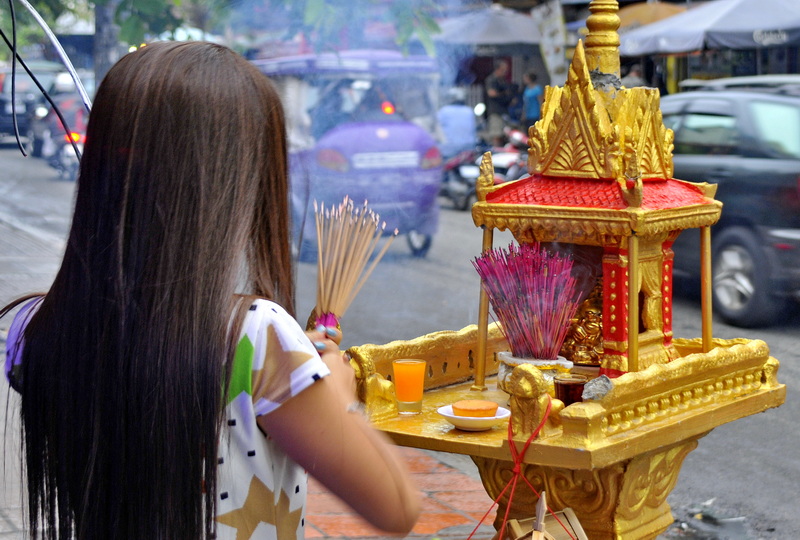 The ubiquitous spirit shrines in Buddhist countries are a leftover from animist times
Cambodia
First, alphabetically in our religions of Southeast Asia, is Cambodia, one of the World’s 5 majority Theravada Buddhist nations. Theravada and Mahayana are the two main forms of Buddhism – there are plenty more as we’ll see later – and crudely speaking could be seen as similar to Christianity’s Protestantism and Catholicism, Entire books are written on the theological differences between the two but to a casual visitor, Theravada is the one with often elaborate wats and the ubiquitous orange robe-clad monks. Again, broadly speaking, Theravada philosophy has the one Buddha while Mahayana Buddhism is a pantheistic religion featuring an infinite number of different Buddhas.
2000 years ago, indigenous Mon-Khmer populations practiced animism – the worship of spirits and inanimate objects such as the sun, moon etcetera – as well as ancestor worship. From the early centuries of the first millennia onwards Hinduism and Buddhism began making strong inroads into the region due to increased cultural and economic contact with South Asia. Early cultures such as Funan, Chenla and subsequently Angkor were predominantly Hindu/Shaivite and indeed Angkor Wat itself is considered to have been dedicated to the god Vishnu. There were clearly Buddhist influences too but it wasn’t until King Jayavarman VII in the late 12th century that Angkor’s official state religion was changed to Buddhism, Temples constructed during his reign, such as Bayon, Preah Khan, Ta Prom and so-on, were built as Mahayana Buddhist shrines.
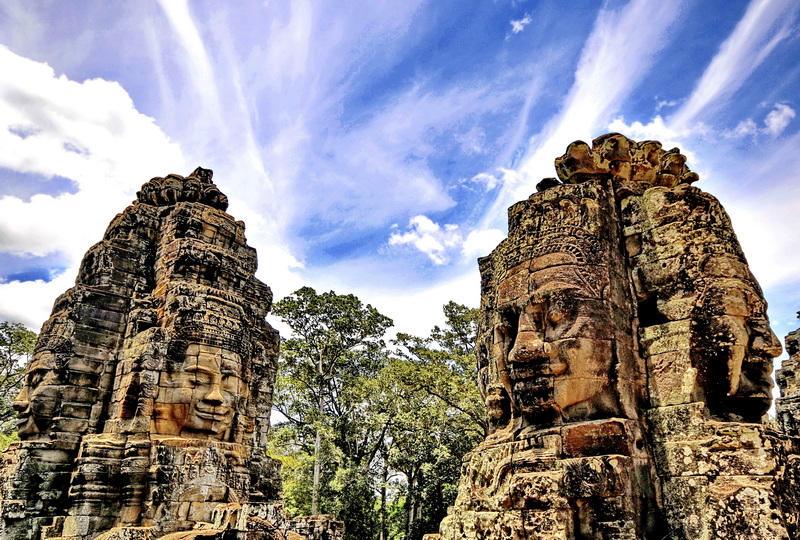 The famous faces at Bayon are though to represent the Boddhisattva, Avalokiteshvara
For various reasons, by the 13th and 14th centuries this had shifted to Theravada Buddhism which has remained the dominant religion in Cambodia up to the present day. A 2024 government census records 96.5% of the population as Buddhist, 2.6% Muslim, 0.3% Christian and 0.6% other, (presumably animist.) Most Khmer Muslims are ethnic Cham, originating from Vietnam. Considering the proliferation of mosques in the suburbs of Phnom Penh, Siem Reap and Battambang plus the significant Muslim diaspora of Kampot and the far south, we find the above, official figure surprisingly small. (Vietnamese Catholic and occasional Protestant churches are also a common sight in some areas.)
Having lived in Thailand for many years we’ve found Buddhist Khmers often somewhat less fervent in their beliefs than Thais. Religion was of course banned during the Khmer Rouge years, many wats destroyed and numerous monks killed, while on a more prosaic level it’s also conceivable that experiencing the horrors of the KR years may have undermined religious faith to some extent, Note that today Khmer Buddhism retains strong animist elements even if they might not be recognised as such by the general populous. The ubiquitous spirit shrines seen across Cambodia as well as Laos and Thailand have no theological justification in Theravada Buddhism. They honour spirits that reside in that house/garden/hotel lobby etcetera and so are purely leftovers from ancient animist beliefs. You will also see neak ta shrines, as they are called in Khmer, at significant geographical locations such as hilltops, waterfalls or at the foot of large trees and we even saw aside a particularly impressive termite mound.
 This unusual floating Catholic church mainly serves the Vietnamese community in Battambang’s Prek Toal Village
Indonesia
Spectacular ancient temples of Java such as Borobudur, Prambanan, Candi Sewu and so-on demonstrate that in early times Hinduism and Buddhism prevailed across much of the Indonesian archipelago. With the decline of the powerful Majapahit civilisation in the 16th century increasing influence of Arab traders and settlers meant Islam spread rapidly in the region, initially in coastal regions and subsequently in inland areas. Animist groups remained in isolated upland and forest areas. (The earliest records of Islamic rulers in Sumatra or Java date to the 14th century.) With 87% of the population adhering to Sunni Islam, Indonesia is famously today the World’s most populous Muslim nation although it does retain a significant 10% Christian minority while Bali, along with certain remote areas of Java, remains Hindu. Hinduism in Bali arrived from Java and even today the larger island’s remote Dieng Plateau features an esoteric Hindu/Animist/Muslim religious fusion. Once again, with coastal regions offering limited possibilities, Christian missionaries concentrated their efforts among the remoter, animist, interiors. Churches are a common sight for instance in the formerly animist, Batak region of Lake Toba.) Buddhism and Confucianism are also recognised by the government and practiced by ethnic Chinese minorities in larger towns and cities.
Indonesia is not an Islamic stare although north Sumatra’s conservative Aceh region has been permitted to apply certain Sharia elements. Rural areas in general are predictably more conservative with larger cities such as Yogyakarta, Surabaya, Bandung etc and of course Jakarta being much more mixed and indeed many first time visitors are surprised by the number of bars and wide availability of alcohol.
Laos
Laos’s numerous minority pe0ples results in much lower numbers of the population describing Theravada Buddhism as their religion. 2016 figures offer 65% Buddhist and less than 2% Christian. The remaining third of the population is grouped as ‘other’ which presumably includes animists and atheists. This possibly downplays the inroads made by Christian missionaries among hill-tribe populations in recent times while many minority people migrating to towns and cities may have adopted Buddhism. Those figures were perhaps more accurate 50 years ago while it is also possible that some 50 years of rule by a nominally Communist government has resulted in a general decline in religious faith.
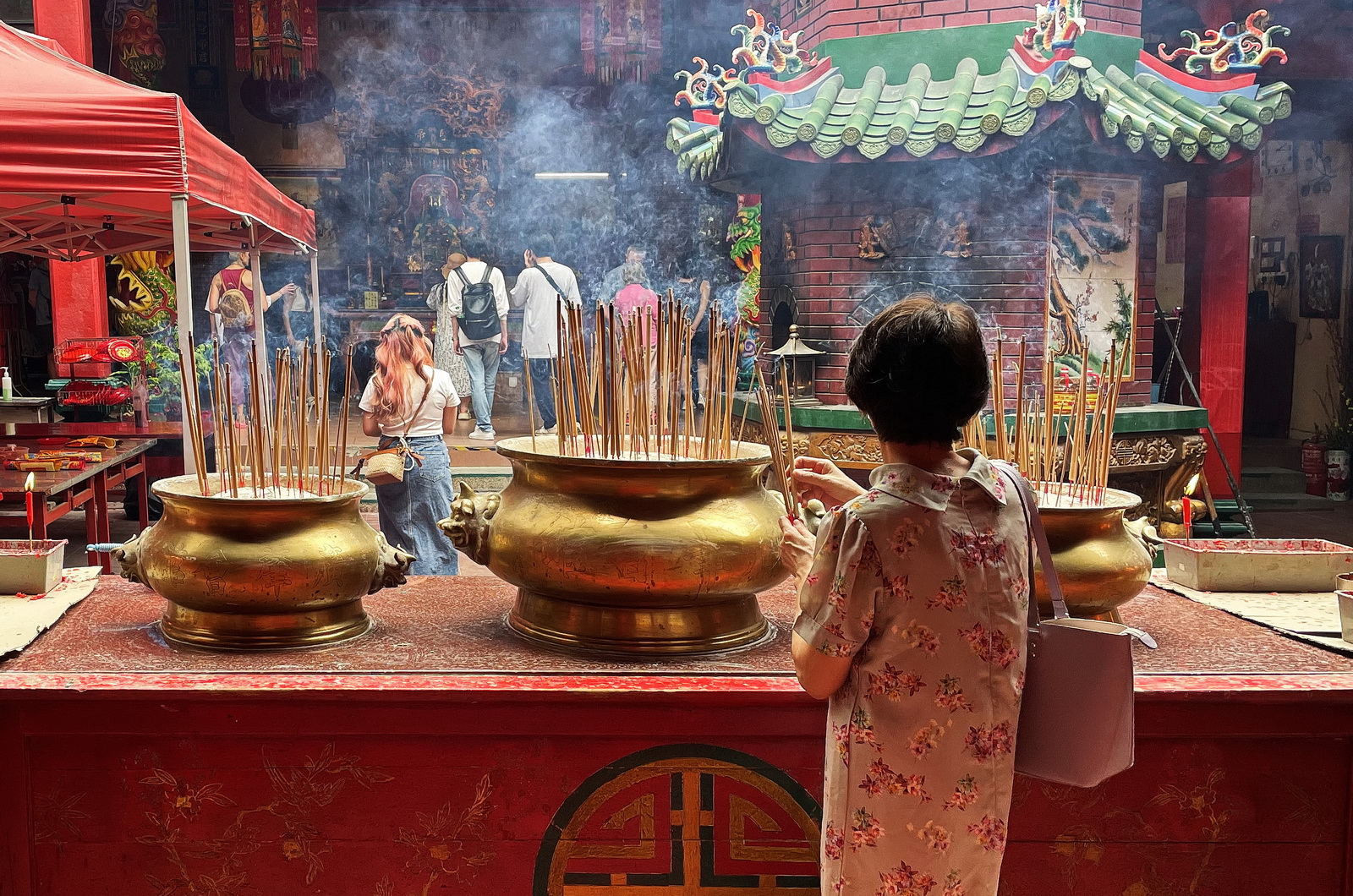 Confucianism, Taoism and various forms of Mahayana Buddhism prevail amongst the Chinese in Malaysia’s urban areas
Malaysia
With its complex ethnic make up, Malaysia is perhaps the most complicated nation in terms of religions of Southeast Asia. As with Indonesia, early archaeological sites in West Malaysia are Hindu and Buddhist – again due to contacts with the Indian subcontinent – with the majority of the population converting to Islam from the 16th century onwards. (This time due to the influence of Arab traders and settlers.)
Today Sunni Islam is the official, state religion and a 2020 government census lists some 63.5% of the population as Muslim. There are distinct advantages in Malaysia to declaring oneself Muslim, including financial incentives, so once again figures may be misleading, Nonetheless, Sarawak State claims Christianity as its primary religion while neither of the largest cities, Kuala Lumpur or Penang, record Muslim majorities. The same survey comes up with 19% of the population following one of the strains of Buddhism which includes the ethnic Chinese majority in the aforementioned cities who practice Taoism, Confucianism and various forms of Mahayana Buddhism as well as ethnic Thai in the north following Theravada Buddhism. South Asian migrants during the colonial period account for the 6% Hindu population, most of which is concentrated in urban areas.
While the British favoured Tamils as plantation workers and Sikhs in police and military roles many Bengali, Muslim migrants also arrived so Malaysian of South Indian origin include both Hindu and Muslim adherents. As is the case in Sri Lanka, subsequent European influences from the Portuguese, Dutch and British account for a 10% Christian minority.
Broadly speaking, urban areas and west coast states are very mixed in terms of religion and ethnicity while rural areas and particularly the northeast states of Kelantan and Terengganu are more homogeneously Muslim and culturally conservative.
Sri Lanka
Another complex mix with a population comprising mainly Buddhist Sinhalese, (c. 70%), Hindu Tamils, (c. 13%) and Sunni Muslims, (c. 10%). The remainder are mostly Catholic. Tamils occupy the northeast of the country – the Jaffna Peninsula and south to Trincomalee – while a second Tamil community inhabits the hill country, having been brought over from India by the British to work in the tea plantations. Muslims traditionally inhabit the east coast and are considered to have been early Malay, Austronesian, migrants to the island. As in the case of Malaysia, Portuguese, Dutch and British influences resulted in the 7-8% Christian minority which is mainly concentrated in the northwest. Negombo for instance is a predominantly Catholic Town.
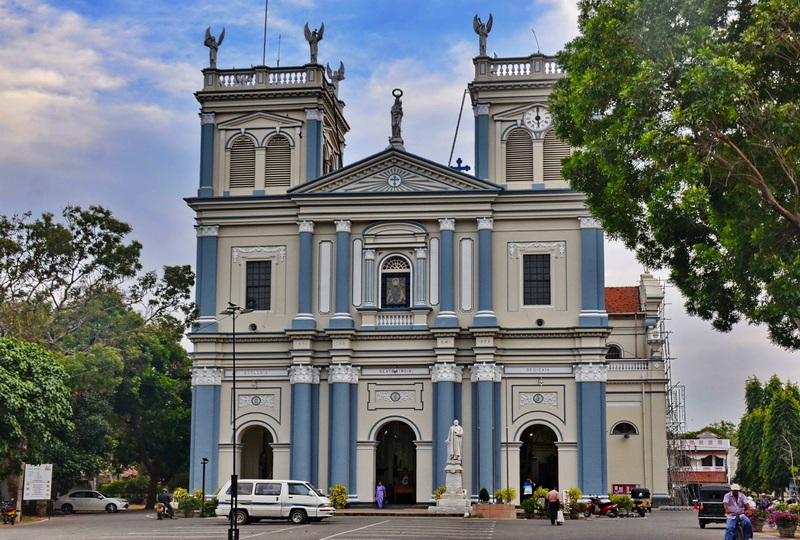 St Mary’s Church in Negombo
Thailand
Until relatively recently much of what is today Thailand was occupied by Mon-Khmer peoples. The early Mon, Dvaravati culture dominated the central plains and Chao Phraya valley while much of the northeast, Isan region subsequently fell under the control of the Khmer Angkor civilisation. Today, spectacular Angkor-period Hindu temples can be seen at sites such as Phimai and Phanom Rung while the ruined Mon-Dvaravati city at Si Thep in central Thailand is now a UNESCO World Heritage Site. Dvaravati was primarily, albeit not exclusively, Buddhist while Angkor was primarily albeit not exclusively, Hindu so these two religions replaced earlier animism. The collapse of the Angkor empire in the 13th century saw migratory Tai peoples from the north expand rapidly southwards to fill the power vacuum from their early capitals at Sukhothai and Ayutthaya. (Note, Tai is the name of the wider ethno-linguistic group while Thai simply describes a citizen of Thailand.) Animist Tai peoples originated in southern China before spreading to what is today Laos and Thailand where they assimilated the pre-existing Dvaravati chiefdoms and city states and adopted their Buddhist religion.
A 2018 census counts 94% of the population following Buddhism, 4-5% Islam and Christianity 4%. Apart from not adding up, the figures appear both over-simplified and inaccurate. While the population is today overwhelmingly Theravada Buddhist the 94% presumably also includes the Mahayana, Taoist and Confucian adherents of the country’s large ethnic Chinese population. (Generally speaking the Chinese minority is far more integrated into main stream Thai culture than it is in neighbouring countries such as Malaysia or Indonesia and Sino-Thais are therefore more inclined to worship at Theravada temples.) Austronesian Muslims form the majority in southern provinces of Pattani, Yala and Narathiwat while also comprising significant minorities in adjacent provinces of Songkhla, Satun Trang, Krabi and Nakhon Si Thammarat.
Northern Thai cities such as Chiang Mai and Chiang Rai house Chinese Muslim populations who originally migrated from Yunnan so a 5% Muslim population would seem to us an absolute minimum. Many animist minorities in the northern mountains – Hmong, Akha, Lisu, Lahu, Karen etc – have converted to Christianity but still account for relatively low numbers while small Christian Thai minorities can be found in most larger towns and cities, particularly Bangkok and the centre. Even so, we’re dubious about equating the Christian and Muslim percentages. Furthermore, while some of the above mentioned hill-tribe, minority groups have converted to Theravada Buddhism, some remain animist which doesn’t appear in the census at all. Taking into account unofficial figures we’d estimate 90% Buddhist, (all strains), 5% Muslim, 4% Christian and 1% animist and ‘other’.
 Prasat Hin Phimai, an 11th century Hindu temple in Nakhon Ratchasima Province
Vietnam
As with all of the above countries featured on our religions of Southeast Asia post, 1000 years ago Hinduism predominated in much of what is today Vietnam. The Cham civilisation occupied central Vietnam and Funan and subsequently Angkor the south and Mekong Delta. The ruined, World Heritage-listed temples of My Son near Hoi An probably represent the best-known Hindu, Cham, site in Vietnam. The ethnic Vietnamese polity in the north and Red River Valley, known as Dai Viet, was heavily influenced by China and practiced forms of Mahayana Buddhism.
As with most other Austronesian cultures of Southeast Asia, the Chams converted to Islam during the 16th-17th centuries while ethnic Khmer populations in the south and Delta had changed their preferences from Hinduism to Theravada Buddhism at the same time as much of late-period, Angkorian Cambodia. Vietnamese expansion into what are today central and southern parts of the country resulted in the imposition of Mahayana Buddhist strains. Cham peoples either fled or were assimilated so today only small Muslim communities, (estimated at 0.1% of the total population) remain in southern Vietnam although a recent national census still counts some 1.3 million ethnic Khmers residing in southern provinces such as Soc Trang, Tra Vinh and Kien Giang. Theravada wats are still a common site in those areas. (A relatively small, Cham, Hindu community, estimated at 50,000, remains in the south central coastal area.)
100 years of French domination led to a significant Christian, (predominantly Catholic) minority officially estimated today at some 8%. With many Christians migrating south during the Indochina war, this community is today concentrated in and around Saigon, (Ho Chi Minh City.) Curiously, since Vietnam is officially an atheist state, several surveys actually list Christianity as the country’s most popular religion with much of the population declining to declare personal, Mahayana affiliations.
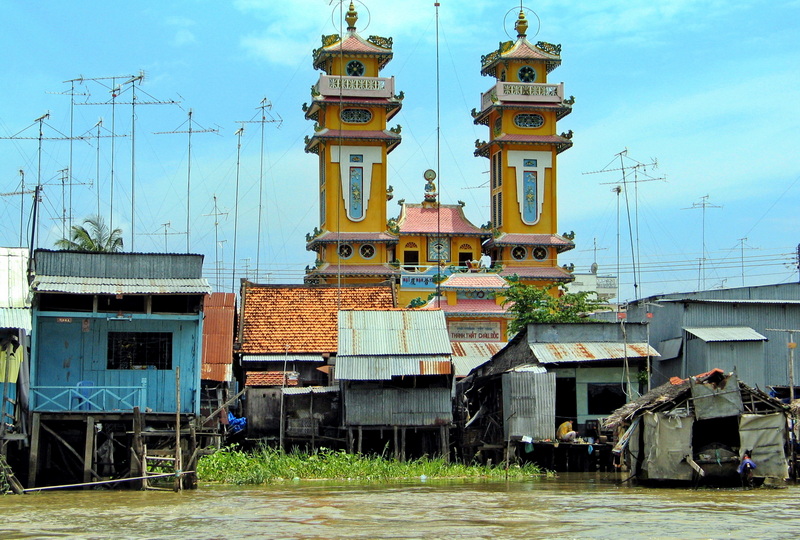 Cao Dai Temple in Chau Doc, Vietnam
Many minority hill-tribes in Northern Vietnam including Tai, Hmong, Dzao etc and montagnard groups of the Central Highlands such as Jarai, Ede, M’nong still practice forms of animism although precise figures are hard to obtain. (The atheist government simply describes most non-specified Buddhist or Christian minorities as practicing ‘folk religions’.) Notable exceptions however are two interesting, southern Vietnamese religions known as Caodaisim and Hoahaoism which are reckoned to represent 1 and 1.5% of the population respectively. Both comprise unique, indigenous philosophies featuring complex belief sets. Of the two, Hoahaoism is closer to traditional Buddhism while the Caodai religion manages to combine elements of Buddhism, Catholicism and Hinduism with traits of 19th century European spiritualism. They believe all religions originate from the one supreme deity, Cao Dai. Jesus, Buddha and Mohamed are thus all prophets of Cao Dai while saints include Victor Hugo. An eclectic collection of minor saints are represented by the spirits of such figures as John the Baptist, Joan of Arc, William Shakespeare, Vladimir Lenin, Charlie Chaplin, and Winston Churchill These are said to be contacted by temple mediums. As we said, curious indeed.


