


The Akha
Although there is some geographical overlap, broadly speaking, the Akha minority today principally occupy a strip of mountains separating the Hmong ethnic group to the east from the Karen in lands to the west. This includes Luang Nam Tha and Phongsaly provinces of far northern Laos, parts of Thailand’s Chiang Rai and Chiang Mai and southeastern Shan State in Burma. In the former, they are concentrated around Muang Sing as well as various locations in the aforementioned Phongsaly, while in Thailand, the highest population is in the vicinity of Mae Salong and north to the border. They are largely absent from northeastern Laos and Vietnam and northwestern areas of Thailand.
The minority belongs to the Sino-Tibetan linguistic-ethnic group and is closely related to the Hani and Yi peoples of China’s present-day Yunnan Province. There are also similarities to Lisu and Lahu languages – two more Sino-Tibetan groups whose villages are often established close to those of the Akha.
 Traditional style Akha houses, Chiang Rai Province
Preferred locations for their villages are high mountain ridges with slash and burn forming their traditional agricultural system. Religious beliefs consist of a complex mix of animism and ancestor worship although many villages today, particularly around Mae Salong, have converted to Christianity.
Akha women’s traditional dress is generally black or dark indigo, with distinctive and highly elaborate headdresses. Three different styles of headdress distinguish the three principal subgroups Ulo, Pamee and Lomi. Their villages are often found in close proximity to each other and the three dialects are mutually intelligible.
 Conical headdress of an Ulo woman
History and origins
Although classified as Sino-Tibetan, there is still some debate among ethnologists as to whether they originated from the Tibetan Plateau or further south in Yunnan. In so far as there are still Akha villages on the edges of the Plateau, while in southern China they are replaced by Hani and Yi, then the former would appear to make more sense. While Hani and Yi languages are closely related to Akha, traditional dress differs significantly. Furthermore, many Akha in Laos and Thailand migrated in recent times (from the early 20th century onwards) so it would appear unlikely that the distinctive dress of migrating clans evolved so quickly upon their arrival in Laos and Thailand. We would then assume that a large number of the Hani subgroup migrated on masse through Yunnan into northern Laos and northeastern Burma. Subsequent conflicts in those two regions subsequently provoked a move further south into the relatively sparsely populated mountainous regions of Northern Thailand alongside their Lahu and Lisu cousins.
 Hani women in Yunnan’s Yuanyang, close to the border with Phongsaly Province in Laos
The Akha today
The mountaintop KMT settlement of Mae Salong, (the town was originally settled by fleeing Kuomintang soldiers after defeat by Mao’s People’s Army), today forms a centre for surrounding villages and traditionally-clad Akha women are ubiquitous in the town’s markets as well as on Sunday mornings outside its churches. Their villages are often remote and integration into mainstream Thai society is generally less advanced than many other hill tribe minorities such as the Hmong or Lisu. (Despite certain of them inhabiting the region for generations, not all Akha have full Thai citizenship.) The same is true for Laos with many villages situated in remote areas of Muang Sing and Xieng Kok in Luang Nam Tha or far-flung mountaintops in Phongsaly – themselves already remote districts in their own right.
 Entrance gate to an Akha village
In former times they were notorious for poppy cultivation while more recently poverty encouraged involvement in the methamphetamine trade; neither of which enamoured them to lowland Thais or Thai authorities. However, crop replacement schemes mean that – particularly around Mae Salong – tea, coffee and temperate fruit growing have provided employment and income and improved the villagers’ situation.
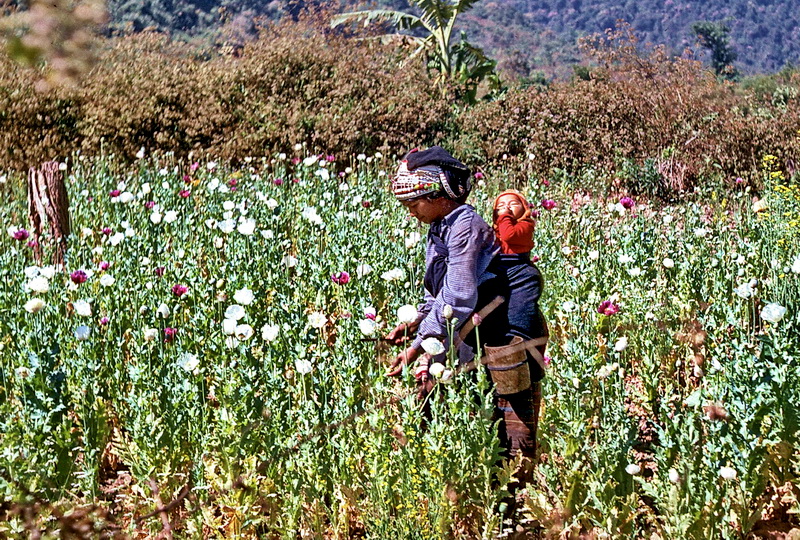 Akha woman with baby harvesting poppies near Muang Sing, northwest Laos
Many Akha women are also extraordinarily enterprising and traditionally dressed street vendors are frequently seen not only in Chiang Rai and Chiang Mai but as far as Bangkok’s Khao San Road and even southern beach resorts, selling their handicrafts and . (Their wooden frogs are ubiquitous while we’ve seen a few inebriated backpackers sporting what purport to be traditional headdresses.)
Our small group Thailand tour, Hidden Thailand, includes 2 nights in Mae Salong with visits to the local market, a tea plantation and a village of the Akha minority.


