


Favourite Cambodian Museums
As a relatively small country with a small, albeit rapidly growing, population Cambodia can’t compete in number of museums with its larger neighbours Thailand and Vietnam (see our recent Vietnam museums post), but it does make up for quantity with quality and our favourite Cambodian museums list includes a clutch of top notch sites, one of which even forms part of a UNESCO World Heritage listing. For obvious reasons, most museums are located in either the capital Phnom Penh or the main tourist destination Siem Reap, but there are several lesser-known, provincial museums which we’d say are well worth a look.
There is a conscious effort on the part of Cambodian authorities to improve the provincial museum infrastructure but at present this remains something of a work in progress. The sooner the better in our opinion as every little helps in trying to extend tourism in the country from its present over reliance on Angkor and Siem Reap, and to a lesser extent, Phnom Penh. Furthermore, the sheer volume of, particularly Angkor-period artefacts, means that only a tiny proportion of these priceless objects are on display at any given time and the vast majority merely collect dust in warehouses. If you’ve got it, flaunt it, and many of said artefacts could be distributed to provincial towns, which is where many of them originated from in the first place.
Our favourite Cambodian museums list will begin with the more obvious, well-known, choices In Siem Reap and Phnom Penh before moving on to suggest a few more off-the-beaten-track sites. Some of the latter category are, as we said, works in progress and could on occasions benefit from judicious use of a duster or new English translations of descriptions and there may well be certain where you’ll have to scour the town coffee or noodle shops to find someone with a key to the museum, but in a way that adds to the charm and the more foreign visitors who show an interest in these sites then the more the incentive to improve them. With an increase in profile of some of these regional destinations – Cambodia now boast five UNESCO World Heritage Sites – we’d expect upgrades to be forthcoming and in, say, five year’s time our favourite Cambodian museums list may look quite different.
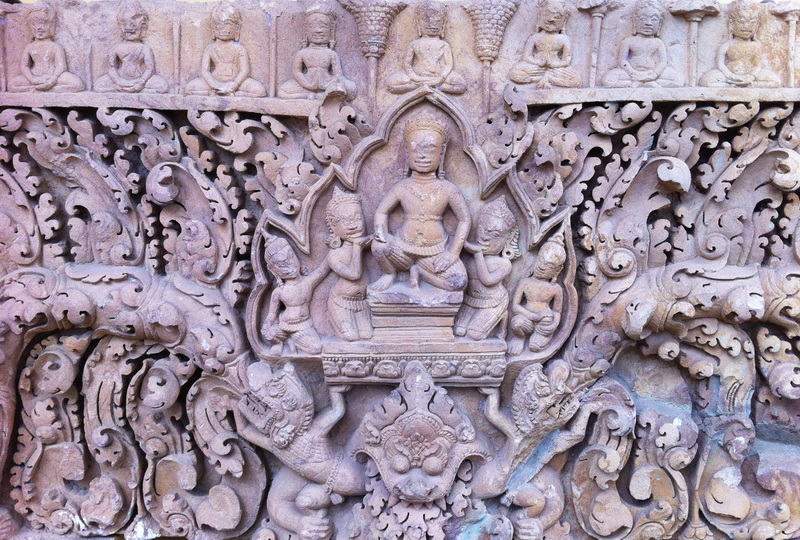 Beautifully preserved 12th (?) century lintel in the rarely visited Battambang Museum
Inevitably, all the entries on our favourite Cambodian museums list focus on either ancient, Angkor period, history or the more recent Khmer Rouge era. Angkor, including the formative Funan and Chenla cultures, lasted from at least the 5th century to the 14th so represents a huge chunk of the country’s history while the impact and over-riding significance of the Khmer Rouge and civil war era far outweighs its relatively brief time-frame. Thailand’s museums for instance cover a rich neolithic and Bronze Age heritage (see World Heritage Ban Chiang), the Mon-Dvaravati civilisation, the 12th to 13th century Lopburi or Khmer era, the Sukhothai, Ayutthaya and Rattanakosin periods, mid-20th century history with Kanchanaburi’s WW2 museums and even sites dedicated to Thailand’s own Communist insurgency during the 70s and early 80s but it is difficult to think of another country where 2000 years of history revolves around two specific themes or epochs.
Phnom Penh
As we said, quality rather than quantity, describes the capital’s contributions. Again, in contrast to, for instance, Bangkok, Hanoi or Kuala Lumpur, you won’t spend days touring the city’s various monuments, historic sites and museums and frankly, with a day and a half, or a leisurely-paced two days, you’ll have covered pretty much most of the ‘tourist’ sites that Phnom Penh has to offer. (Not that we’re knocking the town; Phnom Penh to us is all about soaking up the unique atmosphere and bustling street life in cafes, local markets and noodle stalls and we could spend many days doing just that.)
The National Museum of Cambodia
In terms of size and volume of artefacts (as well as presentation), Phnom Penh’s National Museum has been somewhat overshadowed by the more recently added Angkor National Museum in Siem Reap. Nevertheless, this long-standing museum (opened in 1920) did have first dibs on the country’s vast collection of artefacts so however beautifully presented the Siem Reap collections are, the most prized objects are to be found in Phnom Penh. The exhibits cover the neolithic era up to recent times although, not surprisingly the majority of displays are of Angkorian or pre-Angkor carvings and reliefs. (The latter notably includes a fantastic array of early, 6th to 7th century statuary from the Funan and Chenla periods in addition to some iconic 10th century Ko Ker pieces.)
The venerable old museum building, constructed in a classic Khmer architectural style, is stunning in its own right and partially open, collonade-style galleries surround a small courtyard with plants and ponds. The location, right next to the Royal Palace, is also very convenient and the National Museum ought to be a shoo-in on any favourite Cambodian museums list.
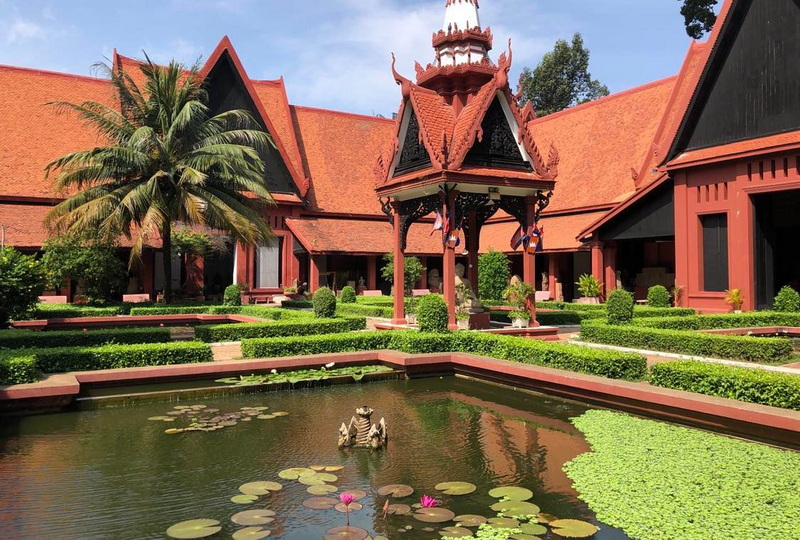 The National Museum, Phnom Penh
Tuol Sleng Genocide Museum or S21
If it wasn’t already well-known enough then the 2025 inscription of Cambodian Memorial Sites on UNESCO’s World Heritage list has further raised the profile of both Tuol Sleng and the Choeung Ek Killing Fields. The former lycée, turned Khmer Rouge prison and interrogation centre, is certainly one of the World’s most harrowing museums, (outside of former Nazi concentration camps), and while many visitors leave in tears, we’ve come across several who refuse to enter. It may then seem rather trite, naming Tuol Sleng as one of our favourite Cambodian museums, but we would maintain it is essential viewing. The museum is extremely informative, in addition to being harrowing, and helps to explain much about Cambodia’s recent history as well as the country’s present day political, cultural and social situations.
Choeung Ek Killing Fields
An historical site and outdoor museum (there are also exhibition buildings), Choeung Ek, in Phnom Penh’s western suburbs, does duplicate, sometimes in an even more graphic way, some of what you will have seen at Tuol Sleng so it is debatable as to whether the two sites are compatible and complementary or unnecessarily repetitive. Nonetheless, the Killing Fields name has an association – in part due to the 1984 movie of the same name – with Cambodia second only to Angkor Wat.
Despite the number of cafes in the carpark or the well-presented exhibitions and videos there’s no getting away from the fact that what you are visiting is a mass grave. Inmates from Tuol Sleng would be taken out to this site for execution and burial in pits containing, by the end of the regime’s reign, nearly 9,000 victims. (As with Tuol Sleng, Choeung Ek is merely one of numerous prisons and execution sites scattered across the entire country.) It is then in a way Tuol Sleng Part 2 so if you’re visiting one you may as well get the full picture but if you wanted to skip one of the two, then we’d suggest this one. As the locals would say, ‘same, same but different’.
Siem Reap
Siem Reap in the western part of the country is home to the Angkor Archaeological Park and consequently Cambodia’s prime tourism destination. Regrettably many visitors simply fly in and out of Siem Reap International Airport and tick Cambodia off their list so even Phnom Penh sees substantially less foreign visitors let alone the rest of the country. Consequently the provincial town does punch above its weight in terms of numbers of museums although we would say some of them appear to be slightly desperate attempts to cash in on the tourist influx.
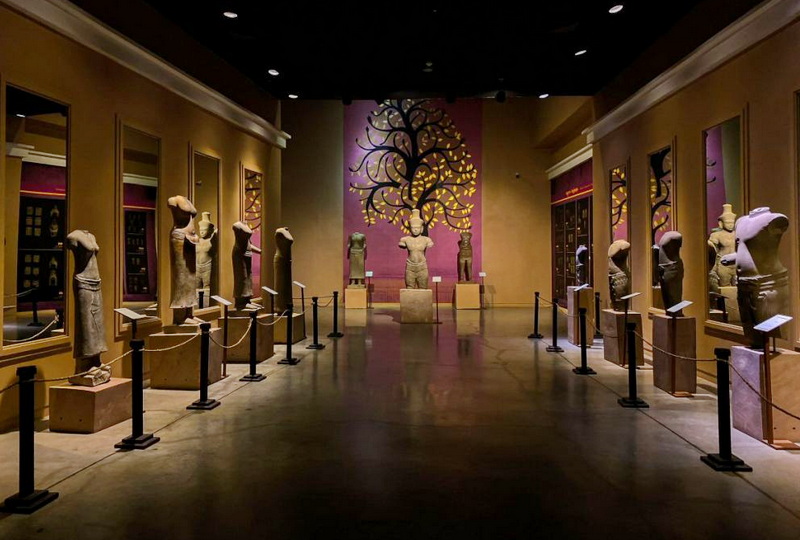 The Angkor National Museum, Siem Reap (Photo, Allan Lim)
The Angkor National Museum
Siem Reap’s purpose-built, state-of-the-art Angkor National Museum was opened on the northern edge of town in 2007 to display just a tiny fraction of the country’s enormous stock of Angkor-period artefacts. The exhibits are beautifully presented although as we touched upon above, many of the mot iconic Angkorian pieces, such as the life sized Phnom Da statues and large Koh Ker figures remain in Phnom Penh’s museum. A definite entry on the favourite museums list nonetheless while it’s also worth bearing in mind that if you are feeling active enough to visit something in Siem Reap’s midday heat, this air-con museum is a great spot to spend a fascinating and cool hour or two.
The Cambodian Landmines Museum
This unique museum (well, we can’t find any others but you never know), situated some 25 kilometres north of town on the way to Banteay Srei Temple, is somewhat out of the way but certainly worth the detour if you have a couple of hours to spare. The museum is privately owned and funded and many of the myriad landmines and UXOs on display were personally dug up by its creator Aki Ra. While millions of mines have been cleared, millions more remain in what is one of the World’s most heavily mined countries and Danger Mines signs are still an all too common sight in the back country. A convenient stop on route to Banteay Srei which fits in well with a visit to the excellent Apopo mine clearance centre.
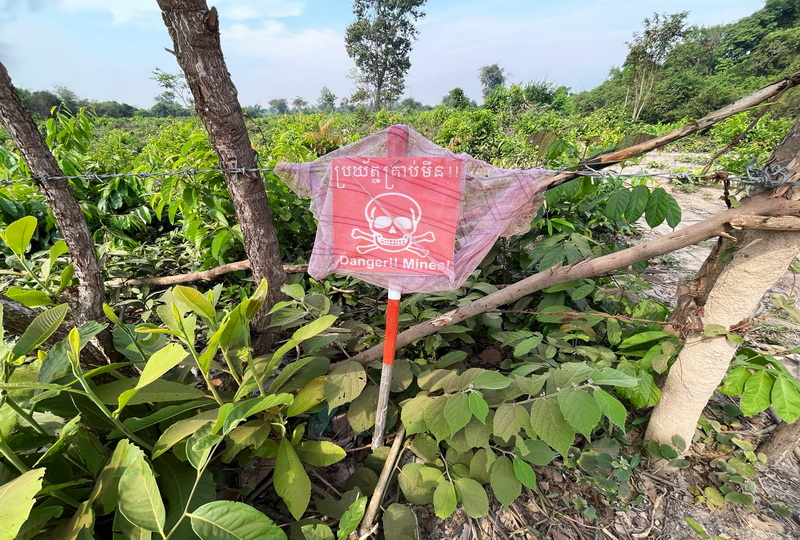 A common sight in certain parts of the country
Provincial Sites
Several provincial capitals do boast their own small museums although few receive more than a handful of visitors in any year and consequently presentation and upkeep are often not what they could be. Opening times may be erratic and while you’ll face dust, cobwebs and sometimes a lack of English signage, many do house remarkable exhibits. We’re yet to see results of the policy to improve provincial museums but the more people who do show up at them, then the greater the incentive, so, while the below are perhaps not worth going out of your way for, we do feel they’re worthy of places on our favourite Cambodian museums list.
Although we haven’t visited yet, the new Preah Vihear Eco Global Museum, shows an odd name but a lot of promise and a visit is scheduled for January.
Angkor Borei Museum
Situated in Angkor Borei Town in South Cambodia’s Takeo Province, this is certainly one of the country’s most off-the-beaten-track and least-visited museums. So, all the more reason for going there! This small provincial town occupies the site of what is thought to have been the capital of the Funan civilisation which existed in the Mekong Delta and what is now southern Cambodia from the 2nd to 6th/7th centuries CE. Little remains of the ancient walled city today but an iconic collection of life-sized, sandstone statues was unearthed at nearby Phnom Da. Principally representing Hindu gods, Shiva, Vishnu, Krishna et al, the style reflects a strong north Indian influence which in turn reflects a Greek/Macedonian style. In Khmer art this style is known simply as Phnom Da, while Greco-Indian art and sculpture is termed Gandhara. Many of the priceless originals have been moved to Phnom Penh for safekeeping and can be seen today in the National Museum so while the ones in Angkor Borei are replicas, several of the other exhibits, including early style carved lintels are original.
This is one where you’ll probably have to search the small town for somebody with a museum key but that adds to the fun and it’s one of the few museums where you can arrive by boat. (You hire a boat in Takeo Town to take you along ancient canals to Angkor Borei and Phnom Da itself.)
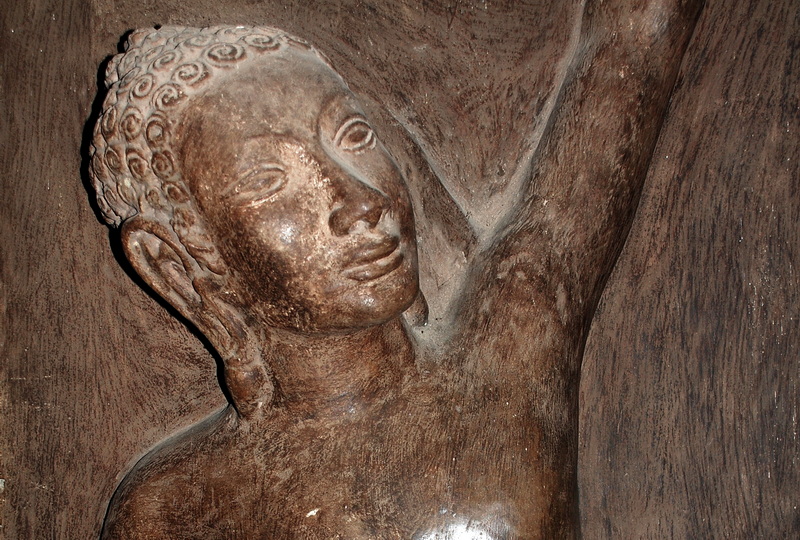 6th Century, Phnom Da-style Krishna relief
Battambang Museum
Considering the relative boom in tourism in Battambang in recent times, its archaeological museum – one of the best provincial ones in Cambodia – is sadly overlooked, Last time we visited, shortly before closing time, the museum’s sole staff member apologised for having to lock up but proceeded to offer me a cold can of Angkor beer and said, ‘but nevermind, we can sit in the garden for a while’. Free can of beer with a $1 entry ticket gets my favourite Cambodian museums vote but the woefully overqualified staff member (a degree in archaeology for just 10 visitors per week in high season) appeared so pleased to chat to a visitor who was interested in, and had a passing knowledge of, Angkorian history. Okay so we may be easily swayed on a hot afternoon by a man bearing chilled beer but the small museum does house some wonderful artefacts. (Note, Battambang possesses two museums, a rather dull city museum in the old governor’s residence and the nearby historical/archaeological one.
Favourite Cambodian Museums on our tours
As is the case with other destinations, our small group Cambodia tours don’t try and squeeze everything in and aim to provide a leisurely pace with downtime for you to do your own thing. Relax by the pool with a cocktail or we’ll call you a tuk-tuk or point you in the direction of the local museum – it’s up to you.
In Phnom Penh, Tuol Sleng and Choeung Ek are pretty much essential viewing and while we do like the National Museum we always felt that seeing the statues and reliefs before visiting the Angkor temples didn’t make much sense as you have no context for, or understanding of, what you’re looking at. Better to do an optional visit during a free period to the Angkor Museum in Siem Reap once you’ve seen some of the temples so you can relate better to the exhibits on display.
The Battambang museum is a short ride from our resort while for the above-mentioned Siem Reap landmines museum, you’d need to count at least 1 hour return travel plus 1 hour visit.
Our Beyond Angkor tour includes World Heritage Preah Vihear temple so we’ll be checking out the new museum on our next departure while the rather far-flung Angkor Borei Museum would be by special request only due to time constraints.


