


Cai Rang Floating Market, Can Tho, Vietnam
In former times every significant-sized Mekong Delta town would have had a floating market with Cai Rang, just outside, Can Tho being the largest and best-known. In more recent time it ought to come as no surprise to learn that Vietnamese shoppers, like their ‘Western’ counterparts, have come to appreciate the convenience of air-con malls and one-stop hypermarkets. Both are, along with bridges and a decent road infrastructure, new phenomena in Vietnam’s Mekong Delta and until recently much of the wholesale buying and selling of fruit and veg took place on rivers, on boats.
The Delta’s vast maze of waterways made getting around by land tricky so farmers would simply load their produce onto wooden boats and head out to designated locations – Cai Rang is situated on the Can Tho River some 6-7 kilometres southeast of the town itself – to rendezvous with market vendors, restaurateurs and so-on. Traditionally, a sample – pineapple, dragon fruit, pumpkin etc – was attached to a wooden or bamboo pole raised above the boat so buyers could identify the proffered wares at a distance. You had larger junks or barges piled with produce, smaller craft hired by customers plus numerous smaller still boats weaving in and out hawking coffees, noodles and so-on. Come daybreak a few boat loads of tourists would join the throng as this was not only the most picturesque scene the Delta had to offer but certainly one of the entire country’s most iconic sights.
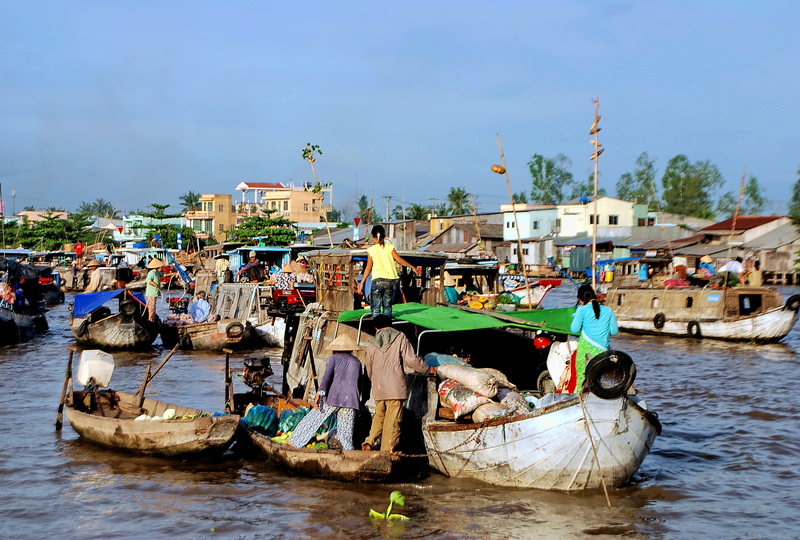 The poles feature sample wares sold by each boat
Indeed it was spectacularly picturesque but at the end of the day far from ideal for either trading party. Farmers and market gardeners needed to factor in the considerable expense and time of a boat plus crew and diesel while buyers needed to get themselves up river at 3.00 am, transfer produce from one boat to another then head back to a jetty, load up a pick-up truck and deliver the goods to the relevant local market or supermarket. You can hardly imagine the buyer at WinMart My Tho or Big C Vinh Long doing this so an additional middleman was necessary.
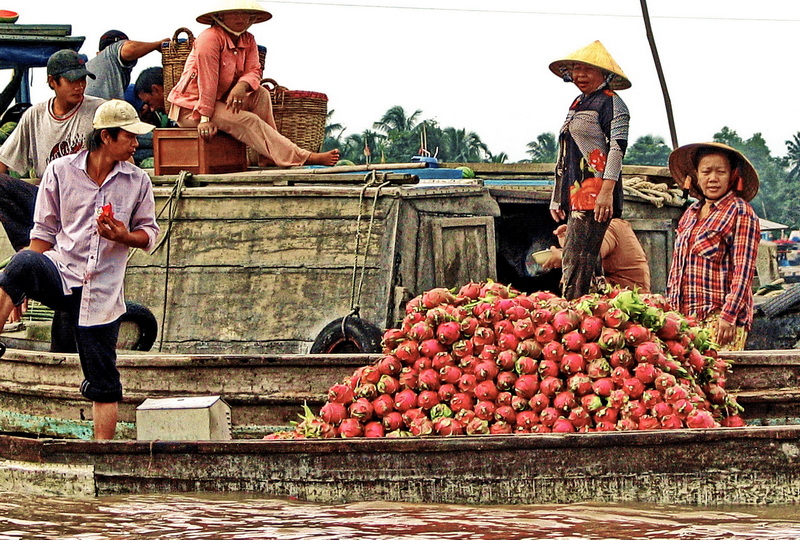 Dragon fruit vendor, Cai Rang
Vietnam’s rapid development over the last couple of decades has seen many of the rivers and waterways bridged and new highways constructed along with accompanying malls and large supermarket chains so the old system slowly but surely faded into the realm of folklore. In 2016, when this process was still ongoing, the Ministry of Culture and Tourism declared the Cai Rang Market part of Vietnam’s “national, intangible, cultural heritage”, which is all very well but didn’t slow the market’s decline and of course however traditional and iconic Cai Rang was, it’s hard to see what steps the Ministry could take to maintain Cai Rang as an authentic feature. They can hardly force locals to do business there. Thailand’s equally famous Damnoen Saduak floating market lost any vague vestiges of authenticity decades ago and today, once past the huge coach park and a/c chain coffee shops, you’d be very unlikely to see any Thai selling or buying anything from another Thai. (Excepting the Thai tourists of course, who are either taking an inevitably disappointing ride down memory lane or who are simply too young to remember what the original market was like.)
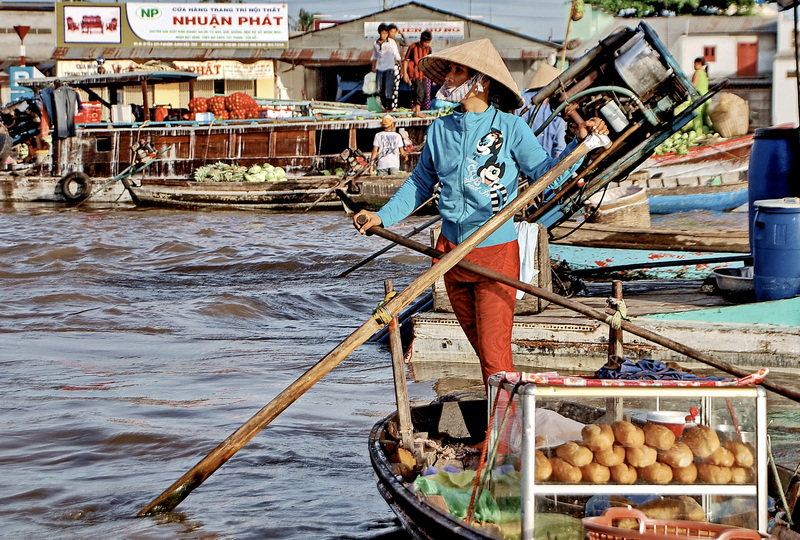 Vietnamese baguette sandwiches or banh mi
While today tourist boats probably do outnumber genuine market boats, Cai Rang happily is yet to descend into Damnoen’s kitsch, tourist trap self parody and on a 2025 trip there were still some boats selling fruit and veg. (A few progress eschewing traders must still remain in the area, unless the Ministry paid them to turn up.) Coffee, juice, banh mi and noodle boats were still paddling around – they can sell to traders and visitors – and while it is admittedly something of a shadow of its former self, we decided the early morning boat trip to Cai Rang was definitely worth keeping on our Vietnam itineraries, albeit with some explanation in the text.
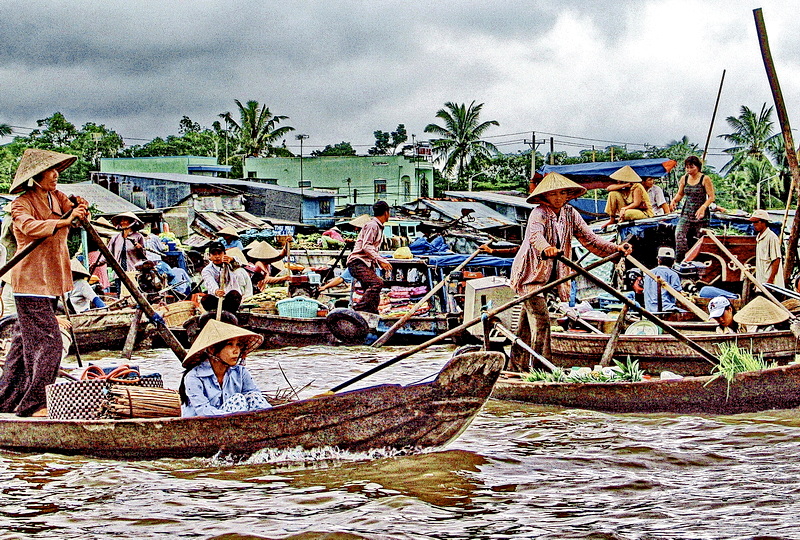 Cai Rang in former times, (2006 photo)
Firstly, we haven’t found any alternative markets to Cai Rang – most smaller ones ceased operating years ago – and it does still manages to conjure up some of its heyday flavour and at least provide an impression of what it would have been like. Secondly, as one of the Delta’s highlights it still features, without caveats, on every other tour company’s itineraries we checked and so if we didn’t include it, we’d spend ages repeatedly explaining why not, without considering those who’d simply zap the All Points East version for another.
Last but not least, we’d say you can’t have too many boat trips in a Mekong Delta programme. Being on a river at dawn can’t be bad, you can still buy a coffee or banh mi from a floating vendor and we can stop for a walk around a riverside market on the way back.


