


When’s the best time to visit North Thailand?
Thailand’s unusual shape and complex geography make any single answer for the whole country impossible so to keep our post to a manageable length we’ve split it into two with part 1 attempting to describe the best time to visit North Thailand and a follow-up post dealing with the south.
Thailand could probably be described as a medium-sized country. At over 500,0000 square kilometres it’s similar in area to Spain, slightly smaller than France or Texas and approximately double the UK. However, the briefest of glances at a map will show you that it does have a distinctly unusual shape and indeed the distance between its most northerly point, Mae Sai on the Burmese border and southerly town, Betong, on the Malaysian border is estimated at 1.650 kilometres. (A round 2,000 by road.)
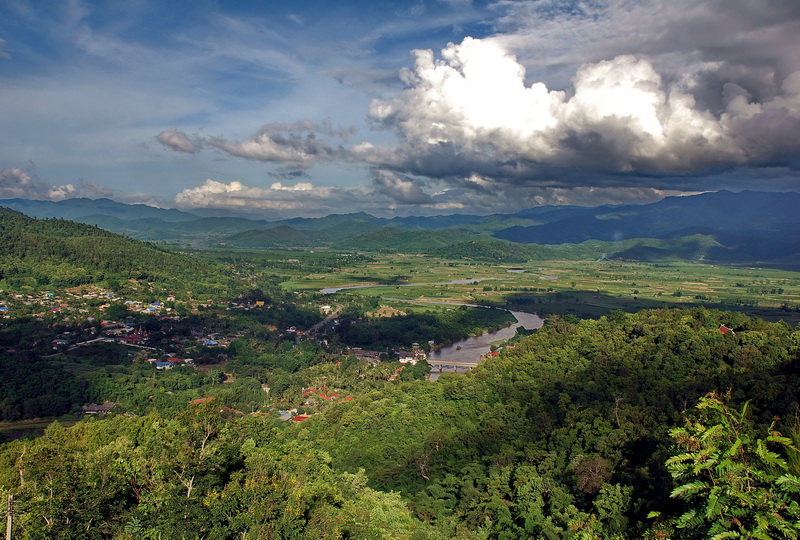 Chiang Rai – Chiang Mai border during the rainy season. Some clouds but green and the river’s full.
The country can be roughly divided into six broad geographical regions: centre, north, east, west, northeast and south. The former refers to the central plains stretching north from Bangkok, with the north, or lower north, generally considered to begin around Sukhothai Province and stretching up to the Burmese and Lao borders. The large bulge to the northeast, also known as Isan, includes provinces east to the Mekong and south to the Dandrek Range, which forms the present-day border with Cambodia. The west is a relatively small, mountainous area comprising Kanchanaburi, which abuts Burma, while the east refers to the coastal provinces between Bangkok and the Cambodian border at Koh Kong and Battambang. The south, then is everything below Bangkok.
As eastern Thailand is mainly relevant for its beaches and islands, we’ll group it with southern Thailand so, the best time to visit North Thailand includes the rest. There are climatic variations between the centre, north, northeast and west but there is a limit to the amount of detail we can cover.
Broadly speaking, there are three seasons: cool and dry from November through to February and hot and dry from March to May with the rainy season falling between May and September or early October. (There are, of course, variations year to year and – as with much of the planet – climatic patterns are becoming less and less predictable.)
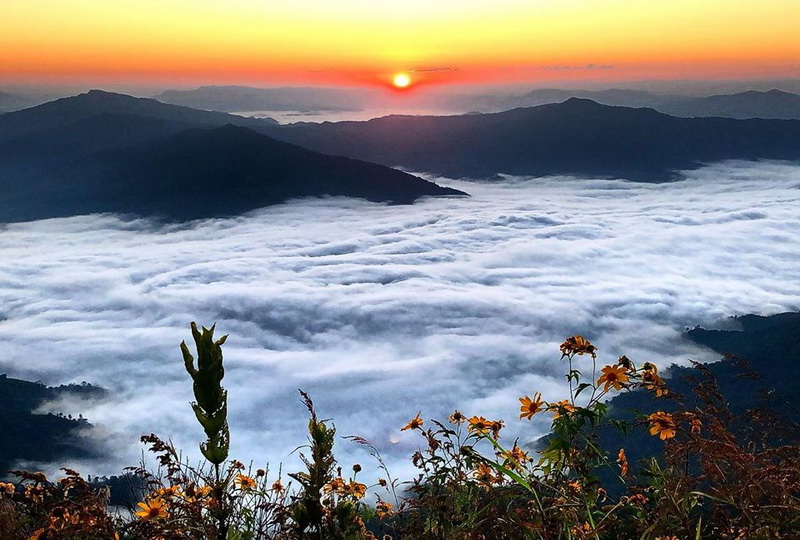 The spectacular sea of mist phenomena occurs during the coolest months
At the risk of being accused of fence-sitting well begin by saying there is no single best time to visit North Thailand and it depends upon one’s priorities as well as the nature of one’s visit. Weather is probably more important for a beach or island stay but north Thailand is about scenery and culture. The least favourable period to visit the north and northeast are the dry, hot months of March and April as landscapes are correspondingly dry and as it’s the burning season for farmers, skies are dusty and smoky while temperatures can get into the low 40s.
While November to early February sees the mildest temperatures, forests, jungles and mountains look their best with some rain. Landscapes are lush and green, rivers and waterfalls at their most spectacular and flora and fauna come alive. Visions of non-stop downpours or constant drizzle during the monsoon season are largely exaggerated and rain tends to fall in short, sharp bursts – often in the evening or at night. (Usually, the worst-case scenario involves sheltering in the nearest coffee shop for 30 minutes until the rain stops.) However, needless to say, it will be more humid so here one’s tolerance to temperature and humidity comes into play. Another important factor to consider is visitor numbers so, with most guides and websites recommending the same, narrow time frame, a relatively limited but very busy high season results. Furthermore, hotels, airlines (and indeed tour companies), know this so it’s supplements all round.
Thinking outside of the box in terms of your timing will mean, often significantly cheaper tickets and considerably fewer visitors at the temple or national park. Various periods have various pros and cons so it’s about weighing them up in the light of your respective tolerances and what you hope to get out of your Thailand tour.
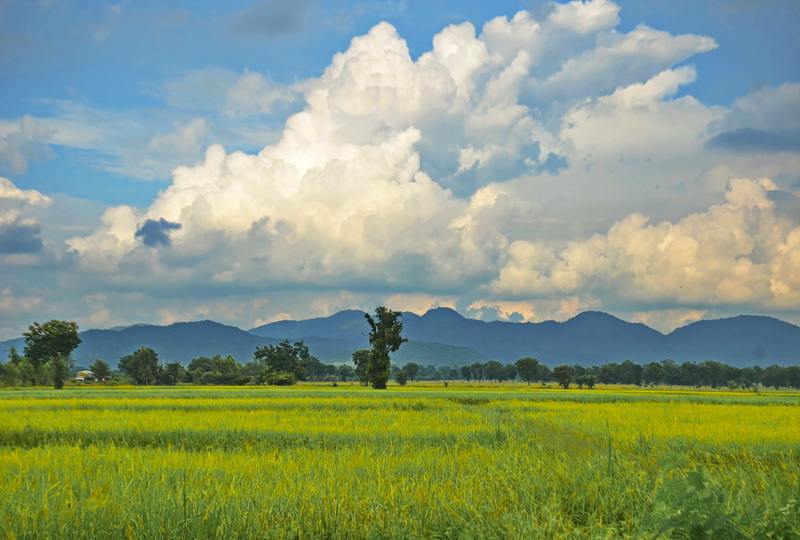 Landscape of the lower north’s Nakhon Sawan during the rainy season
January: pros – dry and cool (cooler). Cons – peak season numbers and prices.
February: pros – dry and cool (early part of the month). Cons – high season numbers and warming up by the end of the month.
March: pros – dry, low season rates and low numbers. Cons – hot, dry landscapes and hazy skies.
April: pros – dry and Thai New Year (13th) is great fun. Cons – usually the hottest months and worst skies.
May: pros – quiet month and rains arrive. Cons – early part can still be warm and dry.
June: pros – one of the quietest months, skies clear and good for flora and fauna. Cons – you’ll definitely get showers
July: pros – also very quiet and great for landscapes. Cons – you’ll definitely get showers
August: pros – great for landscapes, flora and fauna. Cons – showers and visitor numbers pick up with European vacation time.
Sept; pros – probably the quietest month along with June. Cons – one of the wettest months and certain areas may see flooding.
Oct; pros – drier and colder towards the latter part of the month but still quiet.
Nov; pros – cool and dry and still lush from the rains. Cons – one of the most popular months.
Dec; pros – dry and usually the coolest month. Cons – busy and hotel and flight prices at a peak.
While we generally avoid running our north Thailand tour during the hottest months of March and April – and avoid September which is traditionally the wettest month – the rest…is up to you.


