

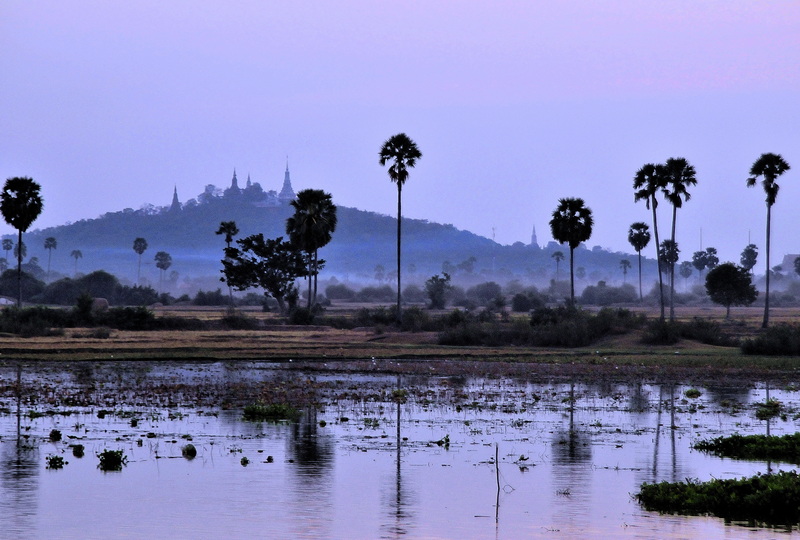
Phnom Udong
You wouldn’t guess today, looking at the scrub-covered low hills surrounded by paddy-fields and red-roofed temples, that the site of Phnom Udong (also written Phnom Oudong) some 40 kilometres north of Phnom Penh, was for a long period the capital of the Khmer kingdom. As in Angkor times, only religious edifices such as the surrounding temples and various shaped and sized stupas that dot the hill were built out of solid materials so the wood and bamboo of the surrounding city houses and the king’s palace have long since disappeared.
 Phnom Udong
When the French turned up here in the mid-19th century, they found a ramshackle wooden town; muddy streets, markets and aforementioned palace scattered across the area at the foot of the hills seen in the above photo. In the 1860s, the remnant of the once great Khmer empire was in the process of being divided up between its powerful neighbours, Vietnam and Thailand. The capital had been looted by Thais, the heir to the Cambodian throne carted off to Bangkok, while the Vietnamese occupied most of the land east of the Mekong. Although the French government’s offer of protection was really only barely disguised colonialism, it did ensure Cambodia’s survival, albeit as a French protectorate, but without the colonial power’s intervention, it almost certainly wouldn’t exist today as an independent country. (Ditto in fact for Laos).
 Looking east from the summit
Udong, or Phnom Udong, is today a very popular pilgrimage site/come picnic spot for Khmers – so probably a good place to avoid at weekends and public holidays – and the trail round the hill is liberally strewn with litter, beggars and highly persistent kids. However, the views are spectacular and there are hundreds of years of historical interest at the site with clear evidence of former Angkor period constructions on the hill.
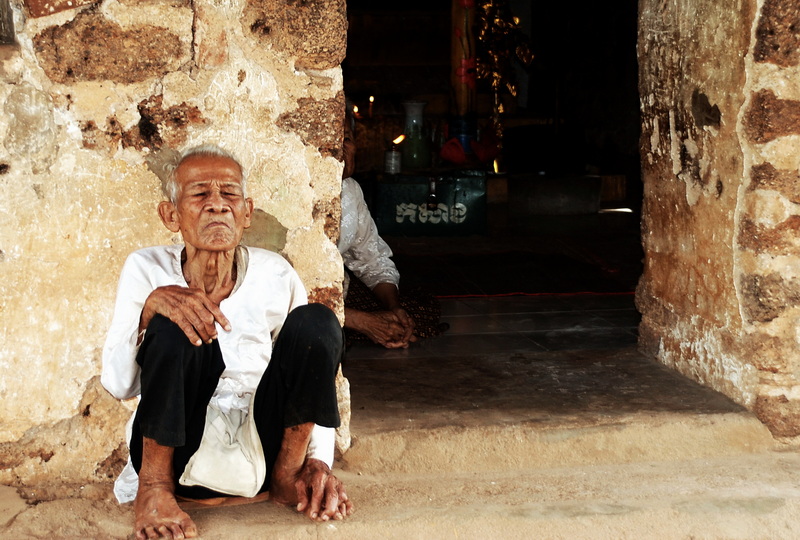 Caretaker at one of the summit shrines
Sandstone and laterite blocks litter Phnom Udong (as well as plastic bottles and Coke cans), and indeed, the remains of a possibly Chenla-period brick tower can also be seen there. Stupas house ashes of various Khmer kings and some of the shrines have been recently restored after being purportedly trashed by the Khmer Rouge so, a site that has certainly been sacred since pre-Angkor times.
You can check all our Cambodia tour itineraries on our Cambodia destination page.


